
Mission
Gather international researchers working on innovative smart robotics technologies to assist emergency responders operating in complex, hazardous environments.
Inspire innovations addressing the needs of emergency responders in a wide spectrum of mission requirements involving mobility, sensory perception, planning, mapping, manipulation, assistive behaviors and operator interfaces and their integration in a holistic manner.
Host annual competitions and additional activities to foster exchange, cooperation, demonstration and evaluation of novel and best-in-class robotic solutions.
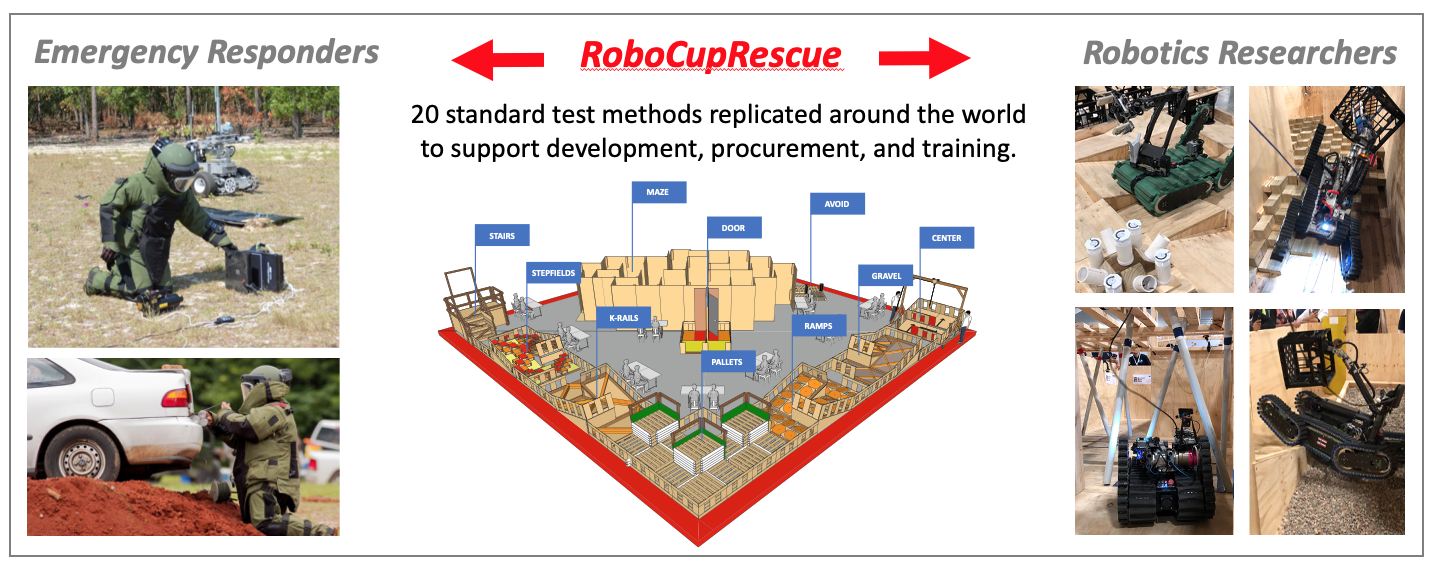
Approach
- Established just before the World Trade Center collapse in New York City more than 20 years ago, where robots were deployed but didn’t do so well (understandably, because it was a horrific collapse). But there are partial structural collapses and many other missions where robots need to deploy.
- Gather teams of researchers capable of developing robotic systems that enable emergency responders to perform extremely hazardous tasks from safer stand-off distances.
- Demonstrate and improve upon the sate-of-the-science in robotics for unstructured environments, with an emphasis on developing autonomous and assistive capabilities that make remotely operated robots more capable and reliable.
- Develop and disseminate standard test methods that emergency responders use to
- Objectively evaluate commercial robots
- Train with objective measures of remote operator proficiency
- Credential robot operators for hazardous missions
- It is a long process to harden and commercialize your robots, but this is the essential first step out of the laboratory toward making a difference for those in harm’s way.
Competition Vision
When disaster happens, minimize risk to search and rescue personnel while increasing victim survival rates by fielding teams of collaborative mobile robots which enable human rescuers to quickly locate and extract victims. Specific robotic capabilities encouraged in the competition include the following:
- Negotiate compromised and collapsed structures
- Locate victims and ascertain their conditions
- Produce practical sensor maps of the environment
- Establish communications with victims
- Deliver fluids, nourishment, medicines
- Place sensors to identify/monitor hazards
- Mark or identify best paths to victims
- Provide structural shoring for responders
These tasks are encouraged through challenges posed in the arena, specific mission tasks, and/or the performance metric. Demonstrations of other enabling robotic capabilities are always welcome.
Concept
The main objective of our league is to conduct challenging and fair competitions that inform teams about the tasks necessary to be effective for responders. We also need to measure progress in our robotic systems to highlight breakthrough capabilities that responders can understand and appreciate. Ten or more successful repetitions begin to indicate a reliable capability. A series of trials across a suite of complementary tests begin to evaluate the system.
The RoboCup Rescue competition is organized in a format that resembles Response Robot Exercises. These have been effective in communicating capabilities between robot manufacturers and responders. Each robot will be evaluated in standard and draft standard test methods during Preliminaries to demonstrate functionality, reliability, operator proficiency, and autonomous/assistive capabilities. The resulting scores will qualify them for a “deployment” into a more complicated scenario in the Finals. This will enable concurrent testing opportunities for more robots to capture statistically significant performance. It will also encourage testing in more complex or difficult settings, challenging robots beyond their comfort level to compile more points.
The Finals will remain a comprehensive search and identification of simulated victims in the overall maze for the best performing robots. Each qualified team is allowed one robot. The maze will consist of all the same test apparatuses and tasks. As always, the search scenario will be conducted from random start zone and performed in any order of tasks the team chooses.
Again we will instantiate a rigorous, standardized process for practicing and measuring league capabilities throughout the year, with competitions being the public demonstration of those capabilities and sharing of results. So we encourage you to build and practice these tests during your development. Then demonstrate your capabilities at competition time for scores.
This new structure will help our league communicate emerging capabilities to responders and allow them to guide such capabilities toward deployment. Local responders may come watch the competition and potentially demonstrate their own robots. This will familiarize them with the test methods and our emerging capabilities, making RoboCup Rescue a leading incubator for robots and test methods worldwide.